
The Empire Has an Expiration Date: How ROB RUN Makes Ambition Mean Something by Taking It All Back

Look closely at the key art for Rob Run and you will notice that the most important object in the picture is not the gun. A man stands with his back to us in a dusty desert town, a bag slung over his shoulders, wind turbines turning on the horizon behind him, and in his left hand, held low and almost casually, he carries a pale clown mask. It is the detail that tells you what kind of game this is, because the mask is not a costume. In Rob Run, according to the guides now circulating, you only become a criminal at the moment you put it on. Until then you are a civilian, free to wander, observe, and keep everything you own. The instant the mask goes over your face, the rules change, the stakes rise, and every other person on the map becomes a potential threat or a potential target.
That tiny moment of transformation is a good doorway into the game, because Rob Run is built almost entirely out of moments where a choice becomes a commitment. It is a free-to-play multiplayer crime sandbox from Kefir, the studio best known for the mobile survival hit Last Day on Earth, and its first game on Steam. Its central gimmick is simple to state and strange to live inside: there are no artificial citizens. Every police officer, every criminal, every pedestrian walking down the street is a real human being. The game launched to enormous attention, with early reports of players climbing past one hundred thousand concurrent on Steam, and a reception that has been mixed, which is almost exactly what you would expect from an ambitious experiment released in Early Access.
This piece is not a verdict. The game is too new, its balance is still moving, and I should be clear that what follows comes from documented systems and early guides rather than hundreds of hours of play. What I want to do instead is take the game’s most distinctive design decision seriously and ask what it is really doing. That decision is not the human-only population, as interesting as it is. It is the server wipe, the scheduled destruction of everything you have built. A criminal empire in Rob Run has an expiration date, and almost everything else in the game makes more sense once you understand why.
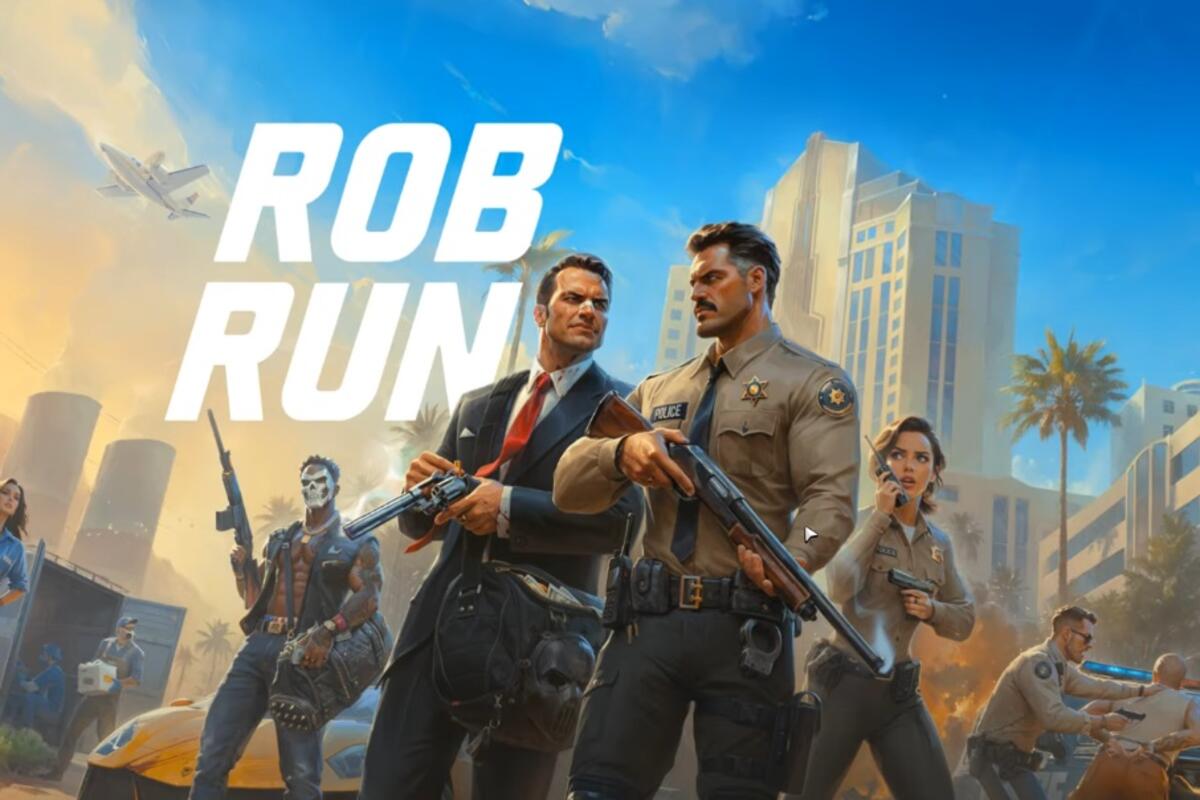
A City Where Nobody Is Fake
Start with the premise, because everything else grows from it. In most open-world crime games, the city is a stage populated by background characters whose behavior is scripted. They flee when you draw a weapon, they call the police on a timer, and they exist to give your actions a visible consequence without ever having stakes of their own. Rob Run removes that layer entirely. The Steam page advertises an environment of up to five thousand real people, and the effect is that every encounter carries the unpredictability of another mind.
That unpredictability changes the texture of even the smallest decisions. A parked car might belong to a player who will notice you looting it. A passerby on the sidewalk might be a cop in plain clothes, or a rival waiting for you to commit a crime. A quiet street might be quiet because nothing is happening, or because everyone is waiting. The game turns paranoia into a feature, and the pleasure of a successful job comes partly from knowing that no script made it possible. Somebody could have stopped you, and nobody did.
It also creates an economy of attention that single-player crime games cannot replicate. Because the city is made of people, the scarcest resource is not ammunition or money but information. Who is online, where they are, what they are carrying, and what they intend to do all matter, and a player who learns to read a street the way a gambler reads a table has a real advantage over one who simply charges in.
The Mask Is a Contract
The way the game handles risk is where its design becomes most elegant, and the mask is the key. Every new player begins as a down-and-out figure fresh out of prison, penniless, with no home, sleeping at a motel run by a character named Lenny, who explains the basic rules. From there, you can explore the starting city entirely as a civilian. As a civilian, according to the beginner guides, you keep your bag and your gear if you die in the city, which means that learning the map, studying how others move, and scouting targets costs you nothing.
The moment you become a criminal, that safety disappears. Dying as a criminal costs you your entire inventory. But the game offers a pressure valve that reveals a lot about its priorities: if the police catch you and you surrender, they take only what is in your bag, and you keep the gear you have equipped. Fighting and losing, on the other hand, costs you both. Desert deaths are harsher still, with everything you carry lost. The structure is a ladder of risk, and each rung has a clear price.
What makes this system interesting is that it turns surrender into a tactical option rather than a failure state. In most games, giving up is losing. Here, giving up is a way of limiting the damage, and a player who knows when to put their hands up may well outperform one who insists on a doomed shootout. The game rewards judgment about the odds, which is a more sophisticated skill than raw aim.
Notoriety adds a second dial. Chaining crimes together during a single visit raises it, and higher notoriety unlocks better deals from the fences who buy stolen goods, but it also triggers a much stronger police response. The game is constantly asking the same question, in different forms: how greedy are you willing to be? The beginner advice that has emerged is telling in this respect. Choose a small target, park facing your exit, grab one bag, and leave. The longer you stay active, the more attention you draw, and the game is built so that attention is expensive.
A few of the choices the mask sets in motion:
- When to commit. Scouting as a civilian is free, so the decision to put the mask on is a real decision rather than a default state.
- What to carry. Your bag is both your loot and your liability, so what you bring into a job matters.
- When to quit. Surrender is a legitimate move, and knowing when to use it is part of the skill.
- How long to stay. Every extra minute raises your notoriety, and notoriety brings real players with real intentions.
Property as a Target
The other half of the game is what you do with the money. Players can rent plots in settlements and build hideouts, which provide storage for loot and vehicles, space for workbenches, and safes for valuables. In another game, a hideout would be a refuge, a place to log off with a sense of security. In Rob Run, it is explicitly part of the competitive loop. Hideouts can be raided, and a well-developed base becomes a target precisely because it contains something worth taking.
This is a smart inversion of the usual base-building fantasy. Most games treat a base as the reward for surviving the dangerous outside world. Here, the base is the new source of danger. The more you invest in it, the more it attracts rival attention, and the game explicitly frames expansion as a trade-off: a better-equipped property offers more facilities and storage, but it also draws the interest of players looking for something to steal.
The result is a kind of continuous low-grade anxiety that gives progress an unusual flavor. You are never simply accumulating. You are accumulating something that someone else wants, and every upgrade is also a decision about how much you are willing to defend. For players who enjoy tension, that is the whole point. For players who want a peaceful building experience, it may be the reason to look elsewhere.
The Wipe: An Empire With an Expiration Date
Now to the idea that gives this piece its title. Rob Run uses scheduled server wipes, which reset the world and restart the struggle for power. The promotional material describes the possibility of rising from nothing to leading the server’s largest organization within a week, and then notes, with a kind of cheerful bluntness, that this climb does not establish permanent status. Even the most successful criminal empire eventually has to start over.

On first reading, this sounds like a flaw. We are used to progression systems that reward persistence with permanence, and a wipe seems to take that reward away. Why would anyone spend a week building something that is going to be erased? But the more you think about the structure, the more it looks like the design’s central insight rather than a limitation.
Consider what permanence does to a competitive multiplayer world. In a persistent game, early success compounds. The players who arrive first accumulate advantages that late arrivals cannot overcome, and over time the server hardens into a hierarchy that newcomers find impossible to challenge. The game becomes about maintaining a lead rather than earning one, and the experience of arriving late becomes the experience of being already behind. A wipe resets that dynamic. Every cycle begins with everyone at roughly the same starting line, and the question is not who has the most but who plays the next stretch best.
It also changes what people are playing for. When the end result is going to disappear, the only thing that can matter is the experience of getting there. The thrill of a heist, the tension of a chase, the alliances that form, the betrayals that break them, all of that is the point, because there is no permanent trophy to justify the effort. A game with wipes cannot rely on accumulation as its reward. It has to make the process itself worth living, and Rob Run’s entire design is geared toward doing exactly that.
There is something almost philosophical in this. A criminal empire that can be built in a week and destroyed in a reset is a very clean picture of ambition as a performance rather than a possession. You are not building something to keep. You are building something to enjoy, to fight over, and to let go of, and the knowledge of the ending gives each stage of the climb a faint theatrical urgency. It is a bit like a sports season: the trophy matters, but what people remember is the games.
The wipe also quietly fixes a problem that plagues most crime-focused multiplayer worlds, which is the problem of consequence without recovery. If losing everything is permanent, the penalty for failure is so severe that players avoid risk. If losing everything is temporary, because a reset is coming anyway, risk becomes more attractive. A bold, doomed raid costs you less when the clock is already running, and bold, doomed raids are exactly what make a crime sandbox entertaining.
Clans, Truces, and the Cheap Price of Betrayal
If the wipe changes how individuals approach risk, it changes how groups approach loyalty. Rob Run lets players form criminal families or join established clans, with roles assigned and raids coordinated across a larger organization. Territory gives these groups a shared objective, and the design includes room for both warfare and diplomacy, with negotiated truces available as an alternative to open conflict. Solo play remains possible, but the game’s ambitions scale with cooperation.
Betrayal is explicitly part of this environment, and the wipe makes it cheaper in an interesting way. In a permanent world, a betrayal can end friendships for good and permanently damage a reputation. In a world that resets, a betrayal is a move in a game that will begin again, and the long-term cost is lower. That dynamic cuts both ways. It makes treachery more tempting, which makes alliances more fragile, which makes trust more valuable. A clan that holds together across a full cycle has achieved something genuinely hard, and the social drama that results is probably the richest content the game will ever produce.
It is also worth noting how this changes the role of the newcomer. Because every cycle begins on relatively level ground, a new player can join a clan, learn from experienced criminals, and make a real contribution within the same week. The wipe is, in a sense, an onboarding system, one that continually refreshes the world’s opportunities. Whether it works as well in practice as it does on paper is a question only a larger sample of players can answer.
Where the Heist Goes Wrong
None of this means the design is free of problems, and the early reception, which has been mixed, reflects some real tensions. The most obvious is that a world made entirely of players is only as good as its population. Every cop, every criminal, and every pedestrian has to come from somewhere, and if the numbers drop, the city empties out. A game that depends on a critical mass of humans is permanently exposed to the fragility of its own community, and the boom-and-bust cycle of free-to-play launches makes that risk very real.
A second concern is the cops. In a game where police are real players, someone has to want to play the law. Criminal fantasies are easy to sell. The patient work of investigation, pursuit, and arrest is harder, and the game’s balance depends on enough players finding the police role rewarding. If the incentives are wrong, the city fills with criminals and runs short of the people who give crime its stakes.
A third is the learning curve and the early hours. A newcomer who arrives with nothing, among players with accumulated resources and knowledge, may find the opening stretch punishing, particularly if experienced players treat novices as easy targets. The wipe helps by periodically resetting the field, but the first hour of any cycle can still feel harsh for those who are unprepared.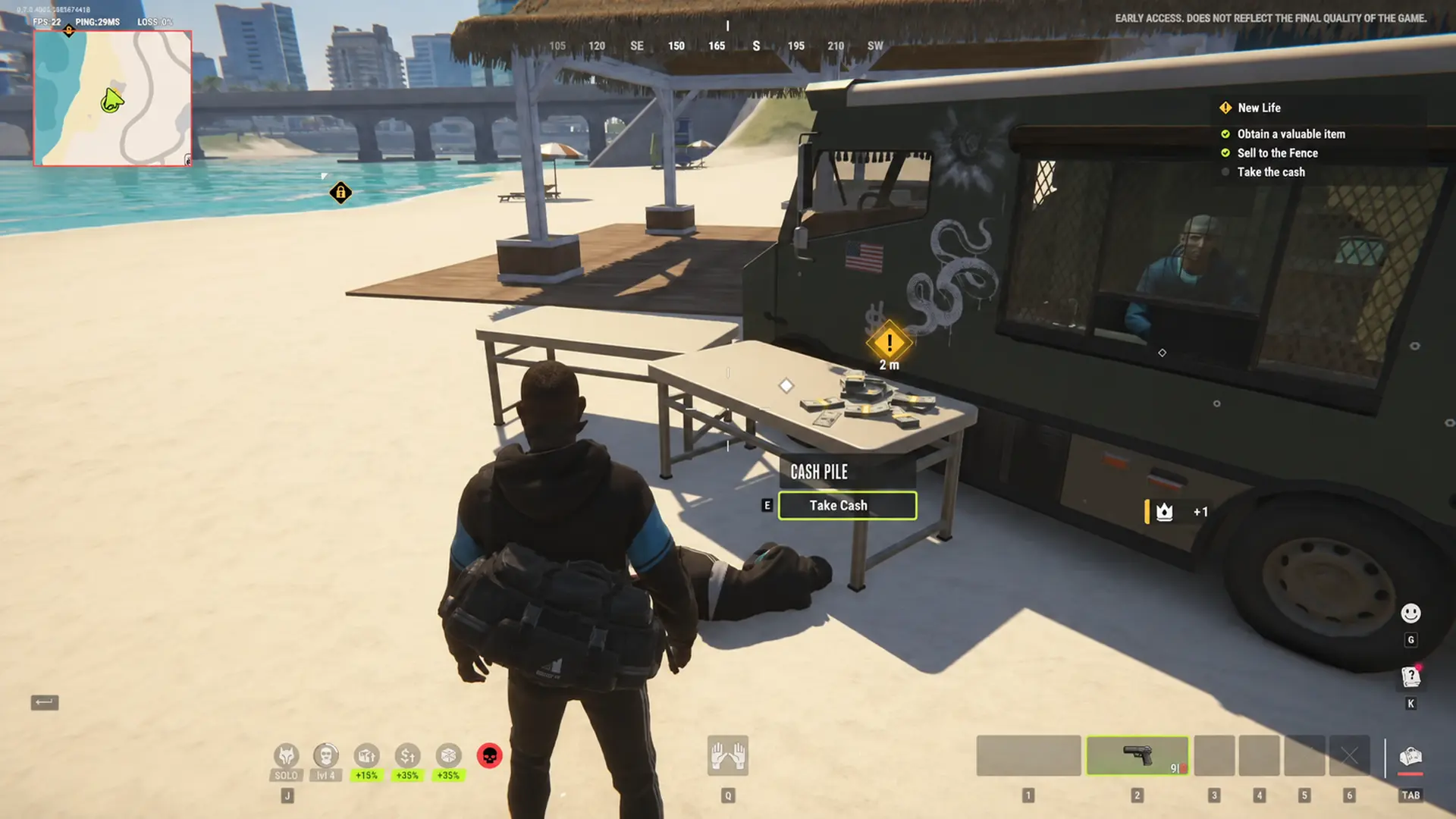
A fourth is the usual burden of Early Access. Systems are still being tuned, rough edges remain, and the experience can change rapidly from one update to the next. A game with this many moving parts, players, factions, property, economy, will take time to find its balance, and some of the frustrations that early reviewers mention may well be addressed in later patches. Others may prove structural.
Finally, there is the question of griefing. Any system that lets players take things from each other will attract those who enjoy the taking more than the game, and a crime sandbox is an especially fertile environment for that kind of behavior. The design leans into conflict, which makes moderation and community tools unusually important.
Who Should Play It, and How
A few practical thoughts for anyone considering a visit to the city:
- If you love emergent multiplayer stories, this is a rare chance to play in a world where every interaction is human, and the wipe guarantees a fresh start every cycle.
- If you prefer predictable single-player crime games, this is probably not for you. The unpredictability is the product.
- If you enjoy tension and risk, the combination of loot, notoriety, and vulnerable property is built to deliver it.
- If you want to build something permanent, consider that the game is designed to take it back.
- If you are curious, start small. Explore unmasked, learn the map, and take a modest first job before committing to anything bigger.
What the Mask Really Means
It is tempting to read Rob Run as simply a GTA-style crime fantasy with a clever online twist. But the more interesting reading is that it is a game about the meaning of ambition when permanence is removed. The mask in the key art is a symbol of that: a small, deliberate act that changes who you are for as long as you wear it, and that can be taken off again when the job is done.
A world that resets is a world in which nothing is ever fully settled, and that instability is both its greatest risk and its greatest gift. It prevents the hardening of hierarchies, it keeps newcomers in the game, and it makes every heist, every alliance, and every betrayal feel like it belongs to a story still being written. Whether Rob Run can sustain that promise across months of updates and shifting populations is the real question, and it will not be answered by launch numbers or early reviews.
For now, what makes the game worth watching is the clarity of its bet. It has looked at the oldest assumption in online games, that progress should last, and wagered that the more exciting alternative is progress that matters precisely because it does not. The empire will fall, the wipe will come, and the city will start over. The question the game poses, one raid, one mask, and one gamble at a time, is what you will do with the week you have.